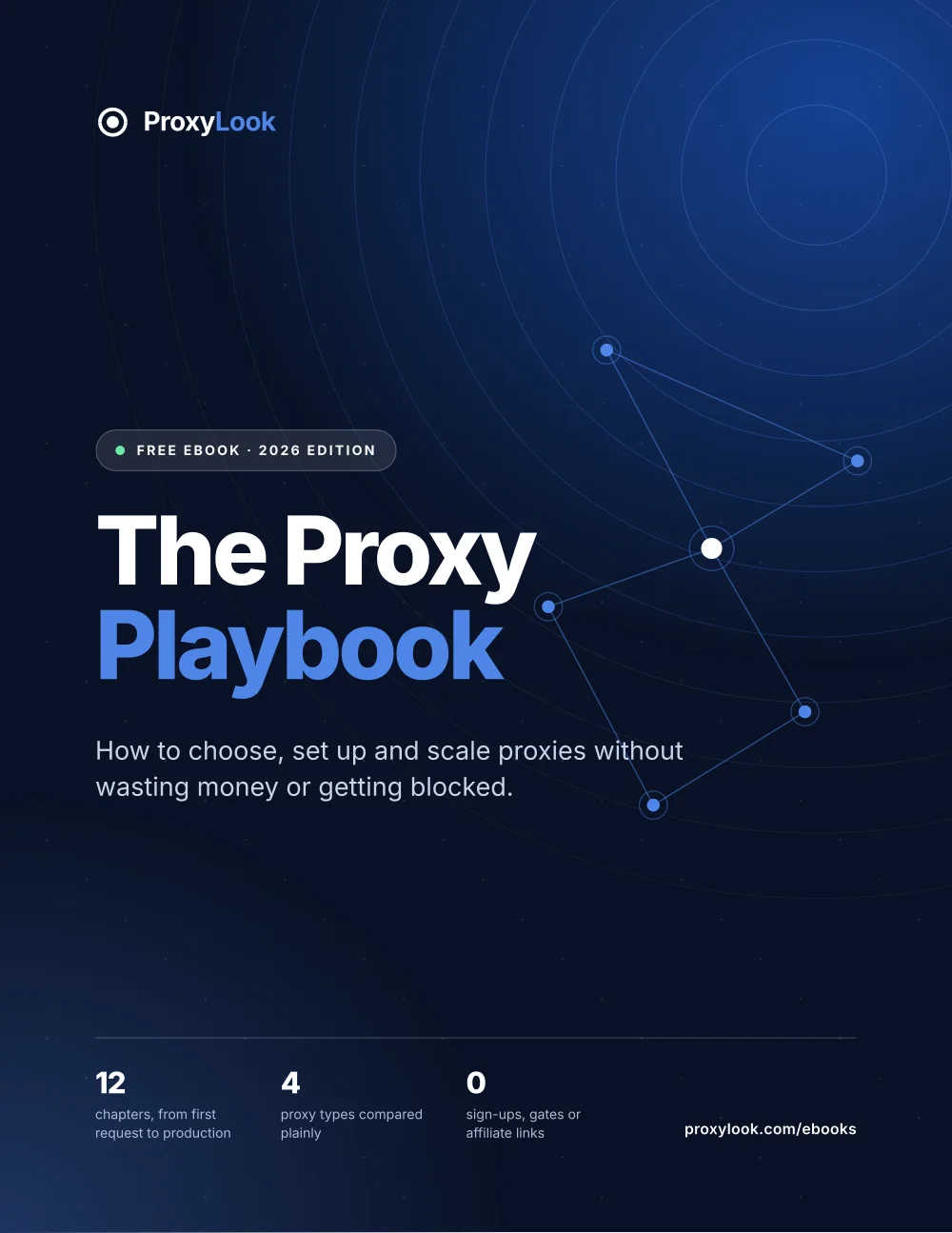
The Proxy Playbook
The free handbook for choosing, setting up and running proxies, from the first request to a production pipeline.
- 12 chapters, from how a proxy works to running one in production
- Working setup code for curl, Python, Node.js, Playwright, Puppeteer and Scrapy
- A provider scorecard, checklists and a 30-day action plan
About the eBook
How to choose, set up and scale proxies without wasting money or getting blocked
Most proxy guides stop at definitions or steer the reader toward one vendor. The Proxy Playbook does neither. It explains how proxies behave on real targets, how to match the type of IP to the job, what a plan costs per successful request, and how to keep traffic from being blocked.
It is built on the questions buyers and developers bring to ProxyLook every week and on the provider data in the ProxyLook directory. Every chapter ends with key takeaways. The appendix holds the scorecard, checklists and reference tables that get reopened when something breaks.
Most proxy problems are a mismatch between the job, the IP and the way the traffic is sent.
By the last page, a reader can
- Explain exactly what a proxy changes about a request, and what it leaves exposed
- Pick the right proxy type for a target before spending anything
- Set up rotation, sticky sessions and geo-targeting correctly
- Work out the real cost of a plan per successful request
- Connect proxies to curl, Python, Node.js, headless browsers and antidetect tools
- Diagnose a block by its symptoms and fix the cause
Look inside
Real pages from the eBook
Diagrams that show how things work, tables to decide from and code to copy. Select a page to see it full size.
What is inside
12 chapters and an appendix
Every chapter ends with key takeaways and is also a web page. Open a chapter to see its sections.
Part I · Understand
01What a Proxy Really DoesHow a request travels with and without a proxy, what the website can still see, and where proxies sit next to VPNs and Tor.p. 6
- The request path, with and without a proxy
- What the website sees, and what stays the same
- Forward and reverse proxies
- Proxy, VPN or Tor
- Anonymity levels live in the headers
- The jobs proxies do
02The Four Proxy TypesWhere datacenter, ISP, residential and mobile IPs come from, how websites rank them, what each costs and how to verify what was bought.p. 12
- Four types, one question: who owns the IP
- The trust ladder
- How the IPs are sold
- Where residential IPs come from, and why consent matters
- What each type costs
- Checking what an IP really is
03Protocols, Ports and AuthenticationHow HTTP, HTTPS and SOCKS5 proxies carry traffic, what each can see, how to authenticate, and how to read and test a proxy URL.p. 18
- HTTP proxies and the CONNECT tunnel
- What the proxy can and cannot see
- HTTPS proxies, SOCKS5 and the HTTP/3 gap
- Two ways to authenticate
- Anatomy of a proxy URL
- DNS leaks
04Rotation, Sessions and Geo-TargetingHow a backconnect gateway hands out IPs, when to rotate or hold a session, and how location targeting trades precision for pool size.p. 25
- One address, many exits: the backconnect gateway
- Rotate per request, or hold a sticky session
- Sessions and targeting in the username
- Geo-targeting: country, state, city, ZIP, ASN
- Static IP lists versus gateways
- Sticky and rotating in Python
Part II · Choose
05Matching Proxies to the JobEight short playbooks that pair common jobs with a proxy type, a rotation style and the pitfall to avoid, plus a ladder for escalating only when needed.p. 31
- Start cheap, escalate on evidence
- Playbooks for collecting data
- Playbooks for verification, accounts and AI
- A decision table for everything else
- Signs of a mismatch
06How Proxy Pricing WorksHow proxies are billed, what list prices roughly look like, and how to turn any plan into one comparable number: cost per successful request.p. 37
- Five ways to bill for a proxy
- What list prices look like
- Cost per successful request
- Bandwidth math
- Hidden costs
- Getting value from a trial
07Choosing a ProviderA 12-point scorecard, a seven-day pilot plan and a red-flag list for picking a proxy provider on evidence instead of homepage claims.p. 43
- A 12-point scorecard
- Pool size, handled with care
- Ethical sourcing and KYC
- Ten example networks
- A seven-day pilot
- Red flags
Part III · Build
08Setup in CodeWorking proxy setups for curl, Python, Node.js, Playwright, Puppeteer and Scrapy, plus a script that verifies the exit IP and a table of common errors.p. 49
- Credentials and a first request
- Python: requests and httpx
- Node.js with undici
- Browsers: Playwright and Puppeteer
- Scrapy
- Verifying the exit and fixing errors
09Browsers, Antidetect Tools and PhonesWhere to set a proxy on desktops, browsers, antidetect profiles and phones, and how to stop the rest of the device giving the real identity away.p. 58
- Where the proxy setting lives
- Firefox, Chrome and extensions
- Antidetect browsers: one profile, one proxy
- Phones: Wi-Fi settings and cloud phones
- Leaks that give the real identity away
- Checking the setup with ProxyLook's free tools
Part IV · Run
10Staying UnblockedHow websites decide a visitor is automated, how a block really shows up, and a cheapest-first order for fixing it.p. 65
- What a website checks
- How a block actually shows up
- Symptom, likely cause, first fix
- The escalation ladder
- When a scraper API or unblocker makes sense
- No setup is permanent
11Scaling and Cost ControlHow to grow a proxy workload without growing the bill at the same rate: polite concurrency, smart retries, caching, tiered routing and four metrics to watch.p. 72
- Concurrency versus politeness
- Retries with backoff and jitter
- Not paying for the same bytes twice
- Tiered routing: cheap first, expensive on failure
- The four metrics worth tracking
- Budgets and alerts
12Security, Law and EthicsHow to keep proxy credentials and traffic safe, which legal questions to ask before collecting data, and a 30-day plan that puts the whole book to work.p. 78
- Why free public proxies are risky
- Credentials and TLS
- The legal questions to ask first
- Robots.txt and rate etiquette
- Residential IPs: sourcing and responsible use
- A 30-day action plan
Reference
AAppendixReference pages to keep open while working: a glossary, a provider scorecard, a pre-launch checklist, HTTP status codes and ProxyLook's free tools.p. 85
- Glossary
- Provider scorecard
- Pre-launch checklist
- HTTP status quick reference
- Troubleshooting order
- ProxyLook's free tools
Who it is for
Written for the people doing the work
Developers and data engineers
Rotation, sessions, retries and block diagnosis, with code that runs as written.
Growth, SEO and e-commerce teams
A plain framework for choosing a provider and a plan, with the cost math done properly.
First-time buyers
The fundamentals in order, so the first purchase is the right one.
Live from the directory
The example networks, with current figures
The book names ten networks as examples and prints no prices. This table reads the ProxyLook directory each time the page loads, so the numbers stay current.
| Network | Proxy types | Pool (vendor-stated) | Listed from |
|---|---|---|---|
| Bright Data | Residential, Datacenter, Mobile, ISP | 150M+ IPs | $5.04/GB |
| Decodo (formerly Smartproxy) | Residential, Datacenter, Mobile | 125M+ IPs (residential + mobile + ISP) | $3.75/GB |
| IPRoyal | Residential, Datacenter, Mobile, ISP | 32M+ IPs | $3.50/GB |
| NetNut | — | 85M+ residential + 5M+ mobile IPs across 195 countries | $3.45/GB |
| NodeMaven | Residential, Mobile, ISP | 30M+ residential + 250K+ mobile IPs, ~190 countries, 1,400+ locations | $4.25/GB |
| Oxylabs | Residential, Datacenter, Mobile, ISP | 177M+ IPs | $4.00/GB |
| Proxy-Seller | IPv4, IPv6, ISP, Residential, Mobile | 20M+ residential + 1M+ ISP/DC/IPv6 across 220+ countries | $1.77/GB |
| ProxyEmpire | Residential, Unlimited residential, ISP, Mobile, Dedicated mobile, Datacenter | 30M+ residential + 4M+ mobile IPs | $3.50/GB |
| SOAX | Residential, Mobile, ISP | 155M+ IPs | $4.00/GB |
| Webshare | — | 80M+ residential + 30M+ datacenter IPs across 195+ countries | $0.99/GB |
Alphabetical order, no ranking implied. "Listed from" is the entry price shown on each provider page. Pool sizes are the vendors' own figures. See the full directory or compare pricing.
FAQ
Questions, answered
Is the eBook really free?
Yes. There is no sign-up and no email gate. The PDF downloads directly and every chapter can also be read online. Sharing it unchanged, with credit to ProxyLook, is welcome.
Who is it written for?
Anyone who buys or runs proxies: developers building scrapers, data and growth teams collecting public data, SEO and e-commerce teams tracking rankings and prices, and people buying a proxy plan for the first time.
Is it vendor-neutral?
Yes. ProxyLook is an independent directory. The book names ten networks as examples in alphabetical order, with no ranking, and it contains no affiliate links.
Why does the book not print prices?
Proxy prices change every month, and a printed number goes stale quickly. The book explains how pricing works and links to live figures on ProxyLook. The landing page shows current directory data.
What format is it in?
A designed PDF with clickable links and a bookmark for every chapter and section. It reads well on screen and prints on US Letter or A4. The same chapters are available as web pages.
Do the code examples work with any provider?
Yes. They use standard proxy URLs and current library versions. Only the username parameters for targeting and sessions differ between providers, and the book shows where they go.
How current is it?
This is the 2026 Edition, compiled in November 2026 from the ProxyLook directory. The online version is updated when details change.
More from the library
Other free eBooks
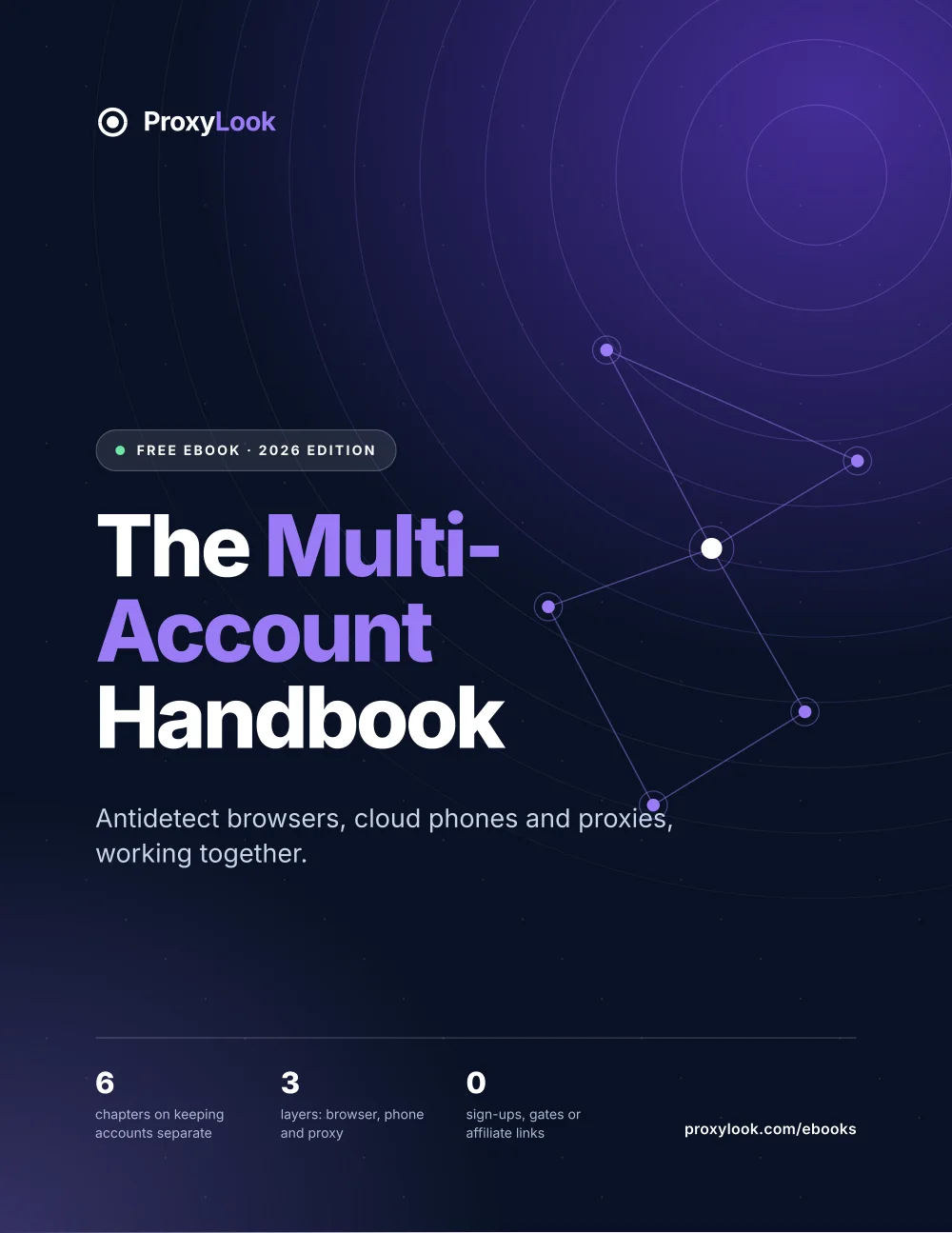
The Multi-Account Handbook
A free guide to keeping accounts cleanly separate with antidetect browsers, cloud phones and the right proxies.
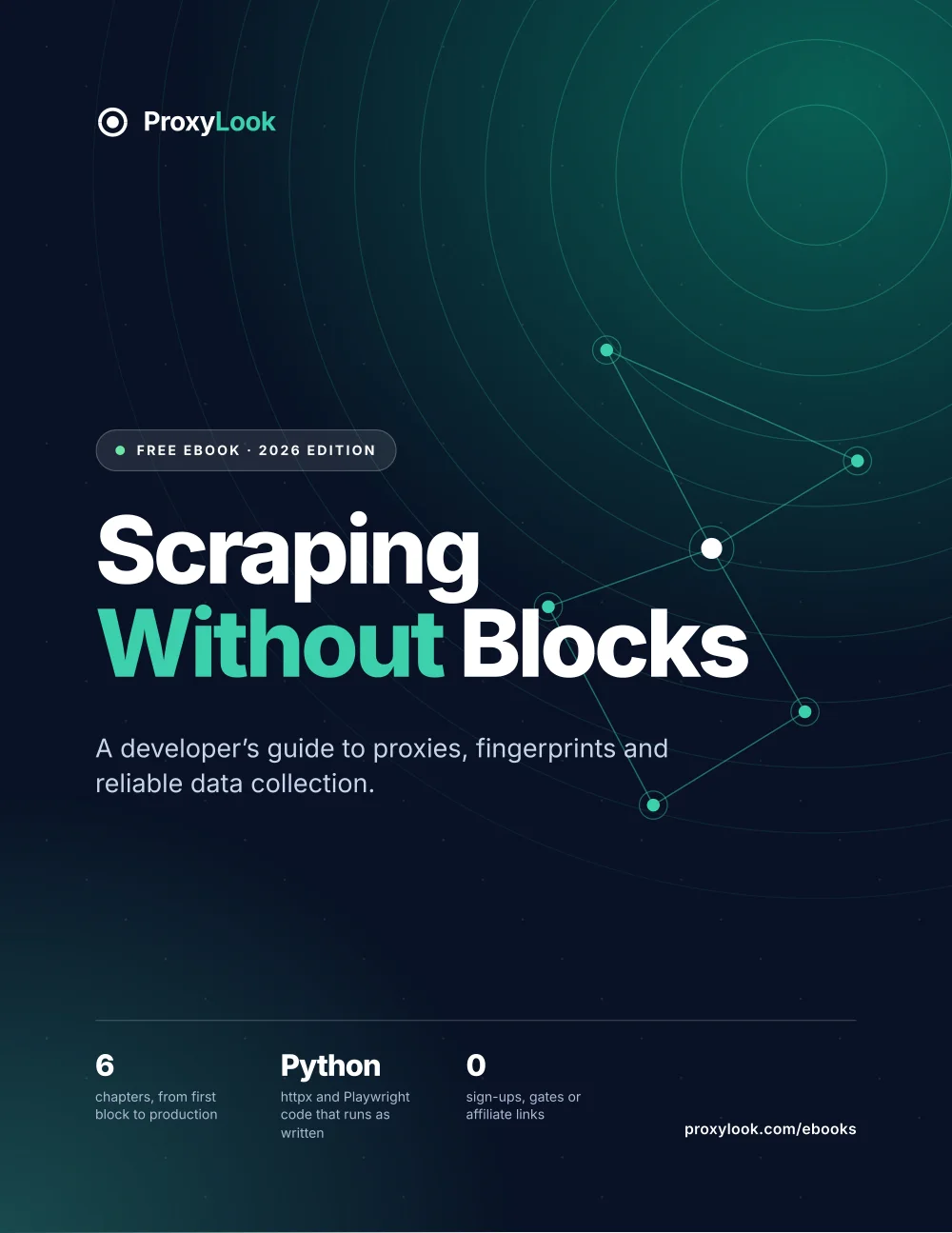
Scraping Without Blocks
A free developer guide to collecting public web data reliably: detection, proxies, resilient clients and production habits.
Get The Proxy Playbook, free
91 pages, no sign-up and no email gate. Keep the PDF, or read any chapter in the browser.